

When my daughters were teenagers growing up in Italy, a group of American high schoolers asked them for Italian swear words they could use. My bilingual daughters, were unfortunately accustomed to that sort of question from both cultures. They also knew well how to play the, “I can’t understand a word of what you are saying,” game in both languages and got away with it. Much like identical twins can switch identities.
They were asked often enough about foul words that they had some already pre-determined answers. It always turned the tables in their favor.
“Matita,” my daughter responded.
“Ma——what?”
“Ma-ti-ta,” she slowly rolled it off her bilingual tongue.
I suppose I need to make sure at this point that you understand my daughters did not use swear words. Matita means “pencil.” They pulled it out of a list of pre-determined innocuous Italian words which when spat out sounded not so nice.
“Sky,”(cielo)! “Floor,”(pavimento)! And “table,”(tavola)! All worked quite well with a little hand waving. Convinced by added gestures and facial expressions, the immature and mistaken speakers repeated “pencil” as if their lives depended on it, feeling clever, tough, and funny. Their facial expressions mimicked my daughters’ furrowed faces. They flailed their hands and quite stupidly spit out, “Matita,” with the finesse of those who thought themselves brilliant.
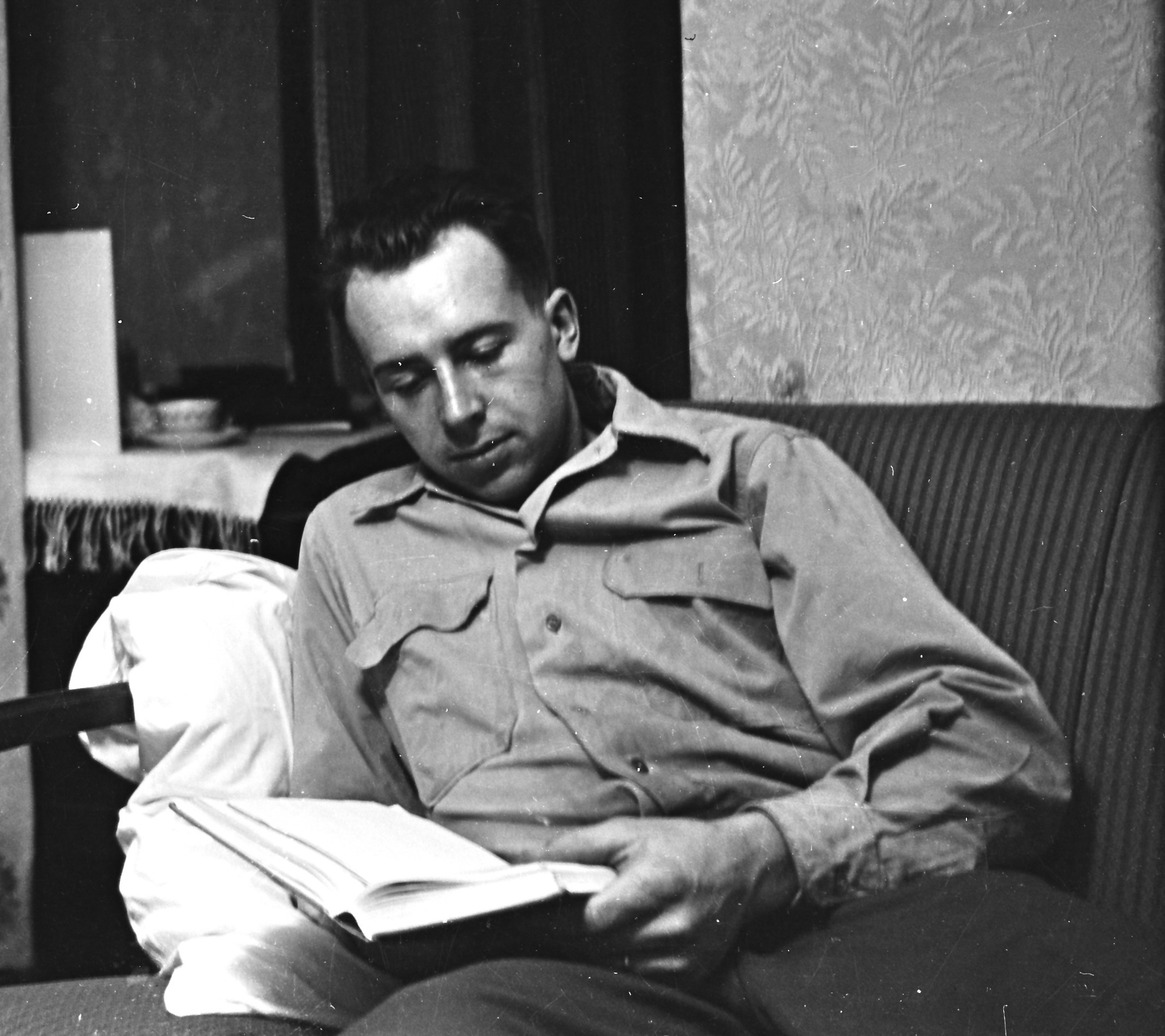
ca. 1949 – Loyd Schroeder
As I listen to what is spoken today on the airwaves, including the most curated speeches, I have a deep desire to respond with, “matita.” Because coarse words are not actually an aid to superior expression, intelligence, or strength regardless of gender or position. And whatever needs to be communicated can certainly be done with precise and clear wording, sans expletives.
“Why would anyone want to say bad words when the English language is full of beautiful words?” my father-in-law often puzzled with a sad shake of his head.
He taught high school literature. He loved the beauty of language. Fluent in Spanish, and professor of the classics, he was a stickler for using words correctly. He firmly believed communication could be accomplished by wise choice and clean wording.Why would anyone want to say bad words when the English language is full of beautiful words? Share on X
My mother, once a one room school teacher, loved language too. Inappropriate words in our house usually got the soap treatment. It effectively erased the soot of what should not be said and replaced it with something better.
Words are amazing things. In the English language we string together only twenty-six letters, scramble them around and with them form unlimited thoughts, feelings, and information.
But, in the Bible, the Word is much much more.
“In the beginning was the Word, and the Word was with God, and the Word was God.” (John 1:1 NKJV)
The Greek, Logos, “Word,” is rich with meaning. From the verb, “lego,” it means “to say,” or “to speak.” But, beyond simple language, Logos reflected expression of thought. And in John 1, it refers to Jesus.
Divine thought. Divine expression. Divine communication.
Christ, from creation to the cross revealed Himself as Infinite God. Logos created the world by His word, breathed life into man, and was Himself clothed with humanity’s finite flesh. Eternal God, Creator of time, conformed Himself to limits of time. The Invisible God, born in a manager and cruelly hung on a cross, became visible, touchable. The Word, spoke, lives, and expressed the exact image of God.
And He abides within His children.
This glorious supernatural indwelling proclaims Him to others through the words we speak and the deeds we do. Those twenty-six English characters of the alphabet that fly out of our mouths, give speech to our inward character. Not one of us represents Him perfectly, in fact most of us poorly, yet we are privileged to be called to share in His language and expression.
When my husband and I studied Italian, another skill developed rather naturally. Our brains found paths to skirt a word we didn’t know or hadn’t yet learned. Inevitably new language acquisition leaves some big vocabulary holes in the journey. And so, as we grew more in our skill, we also grew in finding ways to express what we meant without knowing how to say it. We worked brain muscles we’d never worked before. Kinda like a child learning to talk.
As we are called to reflect Christ, we might need to exercise some new brain pathways.
The Eternal pre-existing Christ, the Word, lives within the hearts of those who have yielded their lives to Him. His Spirit can help find the right words to express our hearts in a way that represents the Indweller. Even if the learning curve is a struggle.
“By the word of the Lord the heavens were made, And all the host of them by the breath of His mouth.” (Psalm 33:6 NKJV)
If my father-in-law were alive today I picture him turning off the T.V. And sadly shaking his head. He would mumble under his breath, “why would anyone want to say bad words when God has birthed language so full of beautiful words?”
Don Pahl
“And that Word, THE WORD, became flesh, and dwelled/ tabernacled among us!” John 1:14
Thank you, Sylvia! Your post today was so … wordy!!!!!😊
Sylvia Schroeder
Was kinda wordy, wasn’t it? Thanks Don! I do love that thought of tabernacling.
Nancy Ruegg
I too am frustrated by the preponderance of expletives used in society today, and heartily agree with your father-in-law. With so many beautiful words to choose from, why stoop to using garbage-language?
Sylvia Schroeder
Amen! Thank you Nancy.
Katherine Pasour
I read your suggestion about developing new pathways–a wonderful action to strengthen our spiritual life and keep our brains sharper. Enjoyed your message and join you in wishing we didn’t use ugly, cruel, or profane words in our society. I’m disappointed that our political leaders and celebraties are such terrible role models when it comes to their language in the public arena and social media.
Sylvia Schroeder
I am grateful for that excruciating exercise when we learned Italian. It’s served us well in English too! Thank you Katherine.